A homeowner in Jasmine Estates called us at two in the afternoon last August, and she was upset in a way I completely understood. Her thermostat had been set to 72 all day. The house was reading 78. The unit had been running without stopping since about ten that morning, her electric bill had just come in higher than her car payment, and she wanted to know what we were going to do about the system a competitor had installed for her two summers earlier. We sent a technician. He checked it for forty minutes and found nothing wrong with it. The system was doing exactly what it was built to do, on a day when the temperature at Tampa International hit 96 and her attic was somewhere north of 140. That is a frustrating answer to get, so this article is the long version of it, including the test you can run yourself before you ever call anybody.
Your AC Was Never Sized to the Number on the Thermostat
This is the part nobody explains at the point of sale. When a system is sized correctly, the contractor runs a load calculation against a design temperature, and for our part of the Gulf coast that outdoor design number is roughly 92 to 93 degrees. The system is then selected to hold somewhere around 75 degrees inside on that design day. That is the deal you bought. It is not a promise that the house will reach 72 on demand in any weather, and it is not a defect that it cannot. An air conditioner does not set a temperature. It removes heat at a fixed rate, and the house gains heat at a rate that changes with the sun, the outdoor temperature, the humidity, and how many times somebody opened the slider. When the gain rate meets the removal rate, the indoor temperature stops falling, and wherever it stops is where you live that afternoon. On a 96 degree August day, a perfectly healthy system landing at 77 or 78 is not failing. It is losing a race it was never entered in.
The Five Minute Test That Tells You Almost Everything
Before you call anyone, measure your temperature split. Get a cheap kitchen thermometer, or two if you have them. Put one in the return air grille, the big one the filter sits behind, and put the other in a supply vent, ideally one close to the air handler. Let the system run for fifteen minutes and then read both. The difference between them is your split, and on a healthy residential system it lands between 16 and 22 degrees. If your return reads 78 and your supply reads 59, you have a nineteen degree split and your equipment is working. Write both numbers down. If a split of 18 or 19 is showing up and the house still will not come down, the problem is not that the unit is broken. It is that the house is taking on heat faster than the unit can pull it out, and everything below is about where that heat is coming from. A split under about 14 is a real finding and worth a service call. A split over about 24 usually means airflow trouble, which is its own problem and can freeze a coil.
Running Constantly in August Is Correct Behavior
Homeowners tell us the unit never shuts off like it is a symptom, and I understand why it sounds like one. It is not. A properly sized system is supposed to run close to continuously on the hottest afternoons of the year, because that is the condition it was sized against. The systems that cycle on and off every eight minutes in August are the oversized ones, and those are the houses that end up cold and clammy, because a unit that satisfies the thermostat quickly never runs long enough to pull the humidity out. We wrote that whole problem up separately in our piece on why a house can feel cold and damp at the same time. Long run times in peak season are a sign of correct sizing. The thing to actually watch is whether the split holds steady through those long runs. A system that starts the afternoon at a 19 degree split and drifts down to 12 by five o'clock is telling you something. A system that holds 18 all day is just working hard.
Do not chase it by dropping the thermostat to 68. This is the single most common thing people do in August and it does nothing helpful. Your system has one speed of cooling and setting a lower target does not make it produce colder air faster. All it does is guarantee the equipment never reaches its setpoint, never shuts off, and runs at full draw into the evening while the number on the wall taunts you. Set it to a temperature the system can actually hold, usually 76 to 78 on the worst afternoons, leave the fan switch on AUTO rather than ON, and let it recover in the evening when the sun is off the roof. Fan set to ON is worth a special mention, because it blows air across a wet coil after the compressor stops and evaporates that moisture right back into your house, which makes the place feel muggier while doing nothing for the temperature.
The Attic Is Usually the Real Answer
Here is what actually happened at that Jasmine Estates house. The equipment was making 57 degree air at the coil. By the time that air reached the back bedroom it was 68. Eleven degrees of cooling were being donated to an attic that was sitting around 140 degrees, through duct that had been in the house since the eighties. Older Pasco and Hernando homes are full of flex duct built to an R-4.2 insulation value, and current Florida code calls for R-8 on supply duct in an unconditioned attic. Add in the sag, the crushed runs behind the air handler, the disconnected boot nobody has looked at since the roof was redone, and the joints that were taped instead of mastic sealed, and it is entirely normal for us to find a system delivering only two thirds of its rated capacity into the living space. The equipment tests perfect. The house is still hot. This is the most common version of the problem we see in August, and it is the one that a duct inspection answers rather than a new condenser.
A Dirty Outdoor Coil Steals Capacity Exactly When You Need It
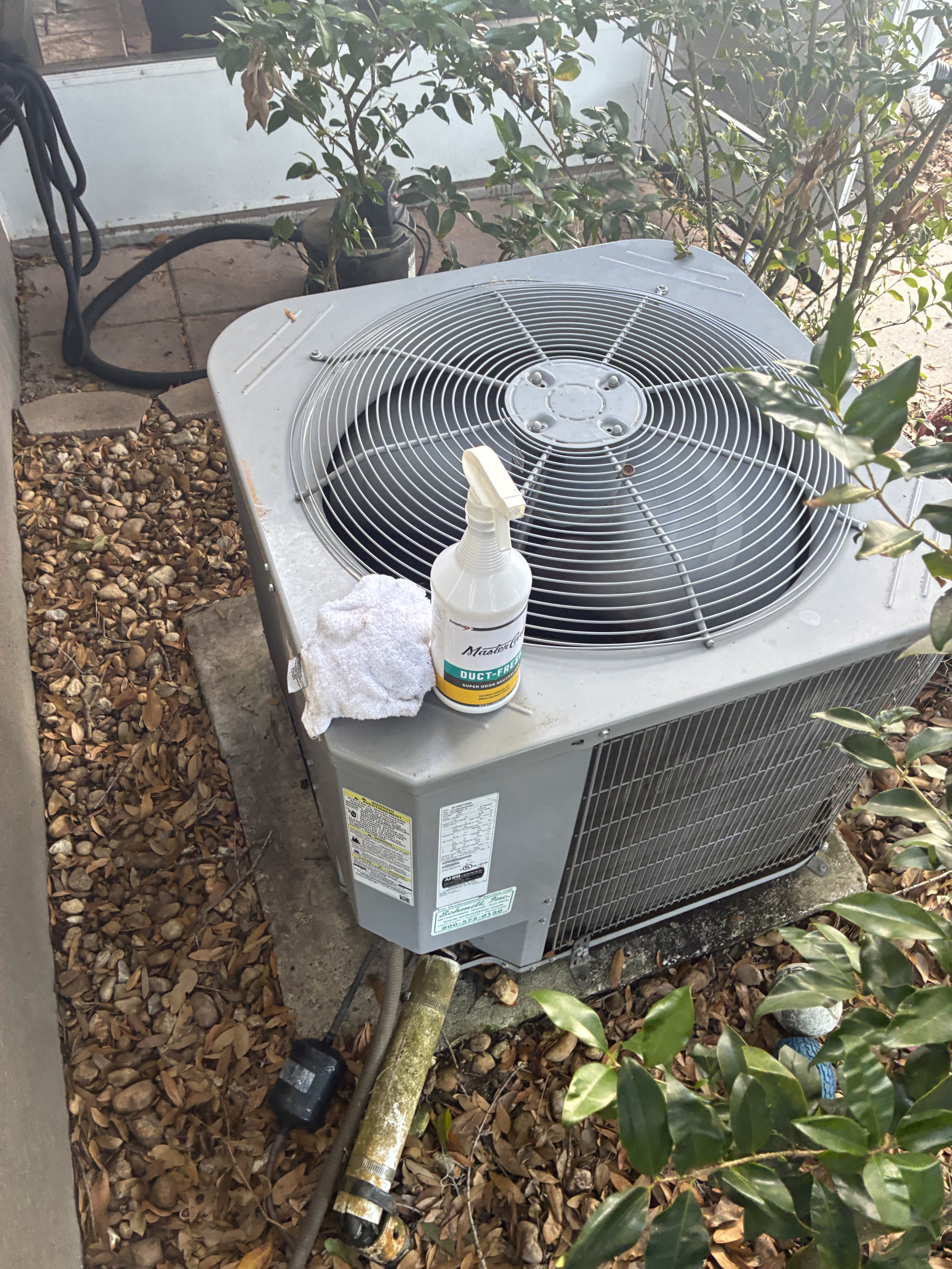
The outdoor unit rejects the heat your house gave up, and it can only do that if air moves freely through the fins wrapping the outside of it. Grass clippings from the mower, cottonwood fluff, dryer vent lint, dog hair, and the fine salt film that everyone near the water in Port Richey and Gulf Harbors lives with all pack into those fins and cut the airflow down. When the coil cannot reject heat, head pressure climbs, and capacity falls off right at the top of the temperature range, which is why this shows up as an August complaint and not a May one. You can improve it yourself with a garden hose, no pressure washer, spraying from the inside out with the power off at the disconnect. Also walk the perimeter and give the unit two feet of clear space. Hedges grown in tight against a condenser are something we find constantly and they cost real cooling. The salt corrosion side of this is worth reading in full in our article on what salt air does to coastal AC equipment.
Low Refrigerant Is Not a Service Item, It Is a Leak
A sealed system does not consume refrigerant the way an engine consumes oil. If you are low, refrigerant left through a hole, and the only honest question is where. Anyone who offers to top you off every summer without ever looking for the leak is selling you an annual subscription to the same problem, and that got considerably more expensive when the industry moved off R-410A. If your system is more than a couple of years old it is almost certainly on R-410A, which is now in phasedown and priced accordingly, and the new equipment sold since January 2025 runs R-454B instead. That transition is worth understanding before you spend money either way, and we broke it down in our article on the 2025 refrigerant change. The right sequence is a leak search first, then a written repair quote, then a decision about whether repairing a fifteen year old unit makes sense at all. Low charge does show up as poor cooling in August, but it should be diagnosed, not merely refilled.
When It Is Only One Room, It Is Almost Never the Equipment
If the living room holds 74 and the back bedroom sits at 80, nothing is wrong with your condenser and replacing it will not fix that room. This is an air distribution problem and it usually comes down to a handful of things we can check in one visit. Most Florida homes were built with one central return and no return path out of the bedrooms, so when the door closes, that room pressurizes, the supply air has nowhere to go, and the flow drops off. The room over the garage and the room at the end of the longest duct run are the classic victims. Closing vents in unused rooms, which feels like it should help, actually raises static pressure across the whole system and makes the imbalance worse. The fixes are ordinary: adding return air, correcting a crushed or undersized run, balancing the dampers, and in some layouts a ductless mini split for the one room that was always going to be a problem, like a converted garage or a Florida room.
The Symptoms That Do Mean Something Failed
Everything above is about a system that is healthy but outmatched. Here is the other list, and if any of these describe your house, stop reading and call somebody. A temperature split under 14 degrees after fifteen minutes of run time. Ice anywhere on the copper line at the outdoor unit or on the coil, which means you should shut the cooling off and leave the fan running to thaw it before anyone can even diagnose it. Water in the pan or a ceiling stain under an attic air handler. A breaker that trips more than once. The outdoor fan spinning while the compressor sits silent, or a hum followed by nothing, which is very often a failed capacitor and the cheapest repair on the truck. A hard electrical smell or a grinding noise. And the one that gets missed: a split that measured 19 in June and measures 13 now. That drift is a leak or a coil going dirty, and it is much cheaper to address in August than in the middle of next summer.
Call Us Instead of Waiting It Out
Run the split test first. If the number comes back healthy and the house is still not comfortable, the honest next step is a look at your duct and your airflow rather than a quote on new equipment, and that is the visit we would rather sell you. If the number comes back low, we will find out why before anybody talks about refrigerant. Either way you get it in writing. Our AC repair and maintenance crews cover Port Richey, New Port Richey, Trinity, Hudson, Spring Hill, Brooksville, and the rest of Pasco and Hernando County under license CAC#1818177. Office number is 727-327-7355 and a real person picks up.