
Skip to content

AC maintenance tips

Eight AC maintenance tips that get a Florida system through August.

Most of them take a flashlight, a garden hose and a cup of vinegar. A few need a licensed technician. Here is which is which, how often each one matters, and when not to spend money at all.

Rufus, Farrell Air Conditioning's mascot

Quick answers

How often should my AC be serviced in Florida?


At least once a year, and twice a year is better here: once in spring before the heat and once in fall. A one-time AC tune-up is $129 to $155 for a single system.

What AC maintenance can I do myself?


Check the filter every thirty days, pour one cup of plain white distilled vinegar into the T fitting on your AC drain line once a month from May through October, and keep the outdoor unit rinsed and clear. Leave anything electrical, and anything involving refrigerant, to a licensed technician.

Is an AC maintenance plan worth it?


Yes, if you would book two tune-ups a year anyway. The two-visit plan is $199 a year, less than two one-time tune-ups, and every AC maintenance plan adds priority scheduling, 10 percent off repairs and a $100 yearly credit toward a new system while membership is continuous.

Before the heat

The first hot Saturday in May tells on every system.

It happens every spring in a house off Mariner Boulevard in Spring Hill, off Little Road in Hudson or off Ridge Road in Port Richey. The first ninety degree Saturday shows up. The air handler in the hall closet kicks on at eight in the morning and never shuts off. By two in the afternoon the thermostat reads 79, there is a film of water on the closet floor, and the filter is the one that went in around Thanksgiving. Nothing has broken yet. It is about to.

That afternoon is the whole case for maintenance. A system here gets no winter off. It runs most of the year, pulls gallons of water out of the air every day, and sits outside in heat, sand and, near the Gulf, salt. Small problems build quietly, then show up together.

Here are the eight habits we would ask of any homeowner in Pasco and Hernando County, how often each one matters and who should do it. After them comes an honest list of where not to spend money, including with us.

The eight tips

What to do, how often, and who does it.

Check the air filter every thirty days

How often: Every thirty days Who: Do it yourself

The filter is the cheapest part of the system, and it protects the most expensive ones. Air passes through it on the way to the evaporator coil, the cold coil inside your indoor unit that pulls heat and moisture out of the house. A clogged filter starves that coil of air. The system runs longer, the bill climbs, and in a bad case the coil freezes over.

Pull the filter once a month and hold it up to a light. If it looks gray or you cannot see through it, change it. Our air filter guide for Florida homes covers sizes, the airflow arrow and MERV, the rating for how fine a dust a filter catches.
Keep the condensate drain line clear

How often: Monthly, May through October Who: Do it yourself

Your AC pulls water out of the air as it cools. That water, called condensate, drips into a pan and leaves the house through a small PVC pipe, where algae grows over a summer until it plugs the line.

Once a month from May through October, pour one cup of plain white distilled vinegar into the T fitting access port, the capped opening a few inches down the pipe from your indoor unit. Skip bleach, which is hard on the PVC glue joints and the metal pan. The Florida Building Code requires overflow protection on this drain, such as a float switch that shuts the system off when water backs up. If your AC quits and the closet floor is wet, that switch did its job. Our post on a clogged AC drain line shows how to clear it.

Rinse the outdoor unit and give it room

How often: Monthly near the Gulf Who: Do it yourself

The outdoor unit, called the condenser, is where the heat from your house goes. It can only shed that heat if air moves freely through its thin aluminum fins. Grass clippings, lint and the salt film everyone near the water in Port Richey and Gulf Harbors lives with all pack into them, and salt also corrodes the metal.

Turn the power off at the disconnect, the small box on the wall beside the unit, then rinse the fins with a garden hose on a gentle setting. Never use a pressure washer. Keep two feet clear on every side. Near the Gulf, rinse once a month. Our article on salt air AC damage in Port Richey shows what corrosion looks like.

Set the thermostat and leave the fan on AUTO

How often: Once a season Who: Do it yourself

Leave the fan switch on AUTO, not ON. A fan that runs nonstop blows air across a wet coil after the cooling stops and puts that moisture right back into the house.

The U.S. Department of Energy suggests 78 degrees when you are home and need cooling. In our humidity, a steady setting between 74 and 78 beats chasing a lower one. Setting 68 on a hot afternoon does not make the vents blow colder. It only makes the system run longer. If you leave Florida for the summer, our guide to summer AC settings for snowbirds explains why an empty house should never have its AC shut off.

Watch indoor humidity, not only the temperature

How often: Once a week in summer Who: Do it yourself

Here, how damp the air is matters as much as how cold it is. The measure is relative humidity, which compares the moisture in the air with the most it could hold at that temperature. The U.S. Environmental Protection Agency advises keeping indoor humidity below sixty percent, and ideally between thirty and fifty. Above sixty, mold and dust mites move in.

An inexpensive humidity gauge from a hardware store tells you where you stand. A reading above sixty with the AC running often points to the fan left on ON, an oversized system that shuts off too soon to dry the air, or humid air leaking in. Our article on the cold but clammy house explains each one.

Book a professional tune-up in spring and fall

How often: Twice a year Who: Technician job

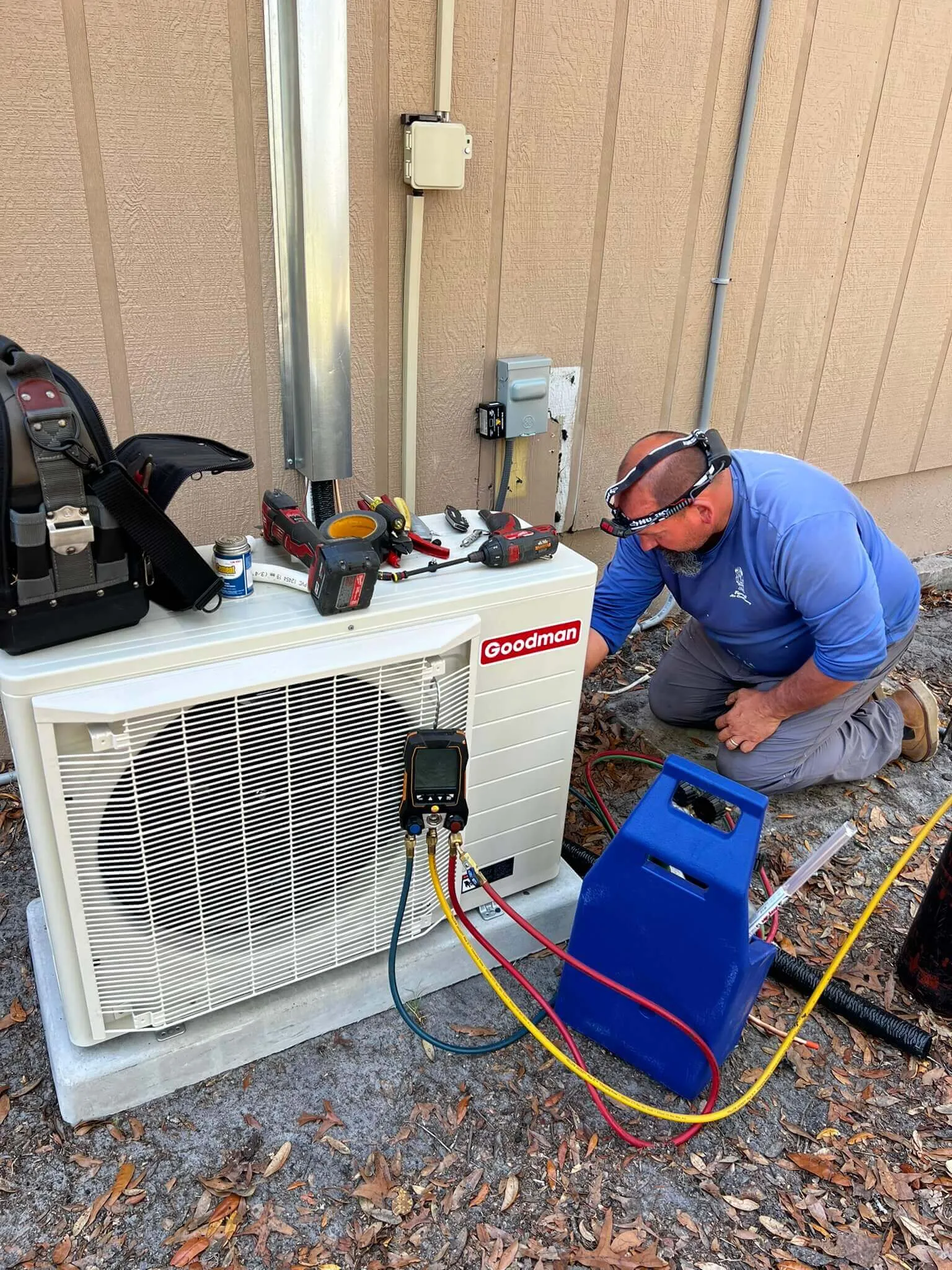
Some checks take gauges, meters and a license. On a Farrell tune-up, the technician checks refrigerant levels and pressures, the thermostat, wiring, contacts, capacitors and relays. The evaporator coil and outdoor disconnect get inspected, the fan and compressor get watched while they run, and the condenser and condensate drain get cleaned.

The capacitor, a small can-shaped part that gives the motors their push to start, gets measured against the rating on its side. One reading more than ten percent low is failing, and our post on AC capacitor failure explains why Florida heat wears them out. A one-time AC tune-up in Port Richey or Spring Hill AC tune-up is $129 to $155 for a single system, with any repair priced in writing before we start. Spring catches problems before the heat. Fall catches what the summer did.

Prepare for hurricane season and lightning

How often: Every May Who: You and a technician

Hurricane season runs June 1 through November 30. Most storm damage to an AC comes from power surges, flying debris and flooding rather than wind. In May, clear a ten foot circle around the outdoor unit and trim anything hanging over it. Do not wrap it in a tarp. Before a storm, turn the system off at the thermostat and the disconnect. When the power returns, wait at least an hour and check for water or damage before turning it back on.

Surge protection is a job for professionals. A protector at the outdoor unit is work we quote in writing, and one at the electrical panel should be quoted by a qualified electrician. Our hurricane season AC prep checklist and our post on lightning surge protection cover both.

Know the warning signs that mean call now

How often: Any time Who: Technician job

Call if the outdoor unit hums but the fan will not spin, or if there is ice on the copper line or the indoor coil. Call for water in the pan, a stain on the ceiling below an attic unit, a breaker that trips more than once, or a burning smell. If you see ice, switch the cooling off and leave the fan running so it can thaw.

One quick test helps. Put a kitchen thermometer in the return grille and another in a supply vent near the indoor unit. After fifteen minutes of running, a healthy system usually shows a gap of 16 to 22 degrees. Under about 14 is worth a call. A diagnostic visit is $90, or $195 after hours and on weekends, and we are open 24/7. Our list of signs your AC needs repair covers the rest.

Straight talk

When not to spend money, including with us.

Maintenance is cheap next to a breakdown. That does not make every charge worth paying. Here is where we would tell a neighbor to keep the money.

  • A refrigerant top-off every summer

    A sealed system does not use up refrigerant the way a car burns oil. If it is low, it is leaking. Topping it off every year without finding the leak is paying for the same problem on repeat.

  • A new system because one part failed

    Florida systems usually last ten to fifteen years. If yours is under about ten and one part gave out, such as a capacitor or a fan motor, you most likely need the part, not a new system.

  • The priciest filter on the shelf

    A MERV 13 or higher filter can choke the airflow on a system not built for it. A MERV 8 to 11 changed on time does more good.

  • A new AC to fix a high power bill

    A bigger August bill is often the weather, a longer billing cycle or a rate change. Compare your kilowatt hours, the usage figure on the bill, with the same month last year, as our guide to a high summer electric bill explains.

  • A service call for a clog you could have prevented

    One cup of vinegar a month from May through October costs about fifty cents. We are glad to clear a clogged line, but we would rather you never need us for it.

A Farrell Air Conditioning technician with gauges connected to an outdoor AC unit

Maintenance plan

Would you rather not keep track of all this?

Our annual plans put the technician's half of this page on a schedule, so the visits happen without anyone having to remember them.

  • $149 a year for one scheduled visit
  • $199 a year for two scheduled visits
  • Priority scheduling
  • 10 percent off repairs
  • A $100 credit per year toward a new system while membership is continuous

Anything we find on a visit is priced separately, in writing, before any work starts. The full terms are on our AC maintenance plan page, and our AC maintenance in Port Richey page walks through the visit itself.

Farrell Air Conditioning holds Florida license CAC#1818177 and works out of two local offices, 6840 Commerce Ave Suite A in Port Richey and 2116 Mariner Blvd Suite B in Spring Hill. The phone is answered 24/7.